Guide · SEO
Healthcare SEO: A Practical Guide for Health Websites and Online Pharmacies
What Google expects from health sites, where they lose traffic, and the order to fix it in.
Key takeaways
- Google holds health pages to a higher trust bar, because bad health information can harm people.
- In our 2026 work, health sites lost traffic mostly to fake trust signals, thin pages and copycat domains.
- Fix trust and site structure first, then build patient-first content that search engines and AI answers can quote.
On this page
- Why health SEO is different
- 1. Trust behind the site
- 2. Compliant, accurate content
- 3. Structures that get suppressed
- 4. Keywords the way patients search
- 5. Content that ranks and gets cited
- 6. Technical basics
- 7. Internal links
- 8. Off-site trust
- 9. Your brand's search results
- 10. AI search
- 11. Measure what matters
- 12. Recover from a spam update
- Start with trust, then grow
- FAQ
- Sources
Healthcare SEO is the work of getting a health website found for the questions patients search. It also means showing visitors as well as crawlers that the site deserves their trust. Think of Google as a careful pharmacist at the counter: before it hands anything over, it checks who wrote the prescription and whether the details add up.
Why Healthcare SEO Is Different
Google's Search Quality Rater Guidelines treat health as a "Your Money or Your Life" (YMYL) topic, where bad information can cause harm. The risk works as a scale. A stretching page carries less risk than a dosage page, and Google expects more proof from the second.
For visitors, that bar is protection, because they need to know a qualified person checked the facts. For crawlers, it means Google's systems give more weight to trust signals on health pages and less benefit of the doubt when something looks off.
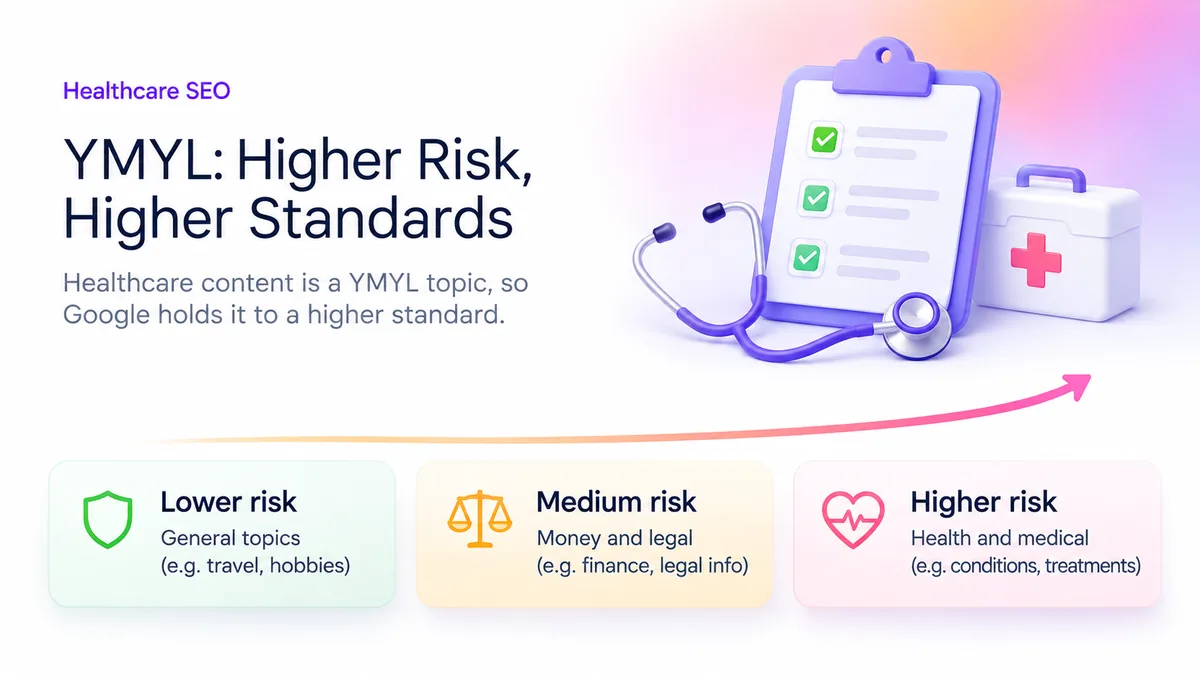
Raters don't change rankings. Google uses their scores to test whether its systems surface trustworthy results. E-E-A-T (Experience, Expertise, Authoritativeness and Trust) is the framework they use, with trust at its center, so you can't switch it on like a setting.
We saw how little slack health sites get in Google's August 2026 spam update, which rolled out from August 18 to 21. Two sister sites of an online pharmacy lost 92% and 97% of their impressions, while the main site kept its traffic. Section 3 explains why.
1. Build Trust Into Who Is Behind the Site
Use Real Authors and Reviewers
Google's people-first content guidance asks you to make clear who created your content. In October 2026, Google added that fabricated creator profiles, such as AI-generated headshots, made-up names and false credentials, are deception.
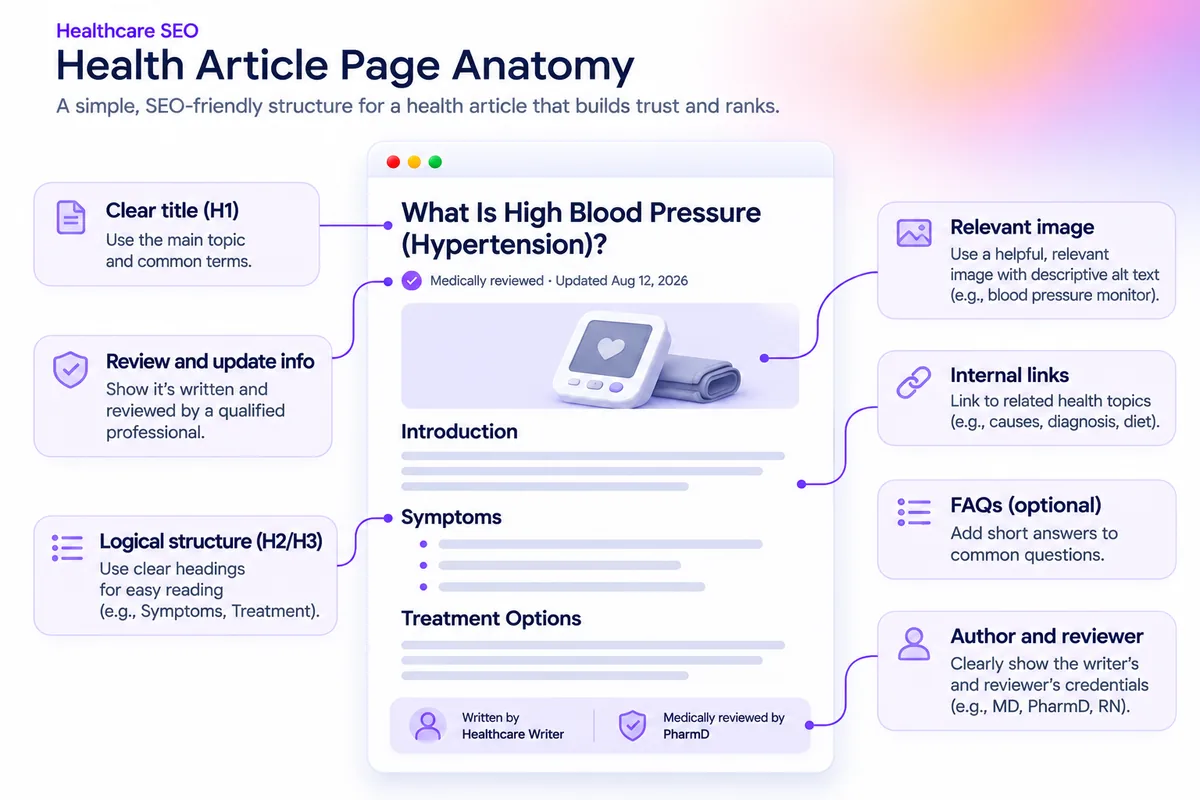
A "medically reviewed by" line with the reviewer's name, credential and date only helps when the reviewer is real. If you have no clinician, label the writer honestly, for example "health writer, not a doctor or pharmacist."
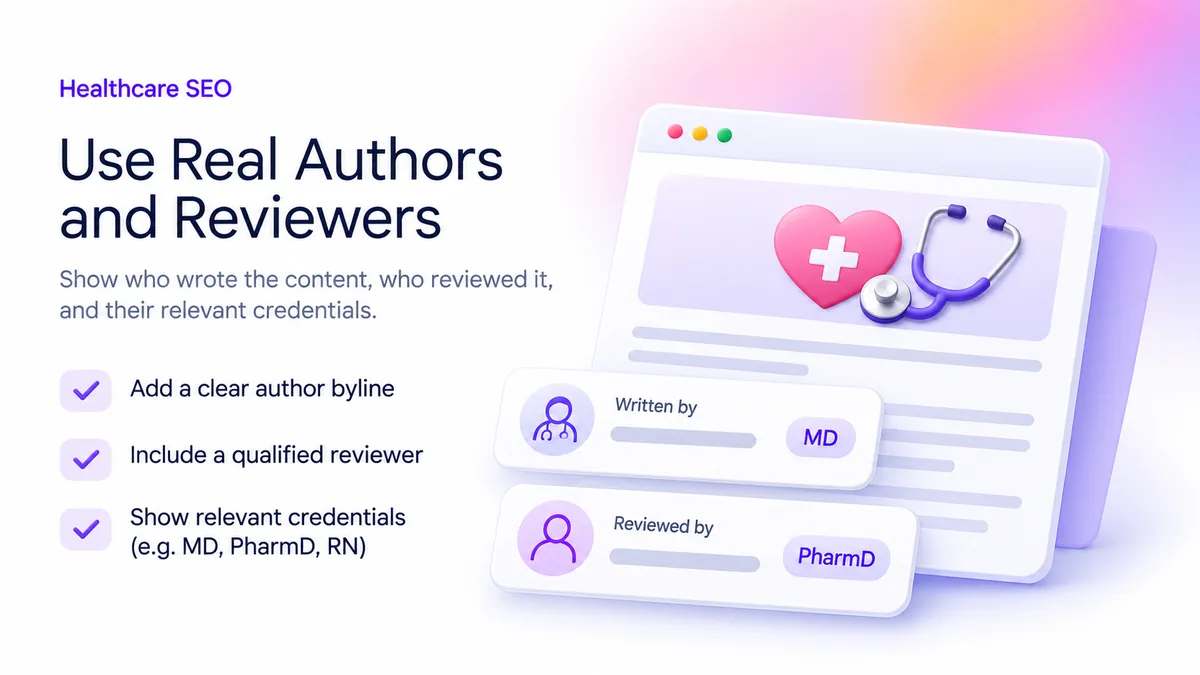
In our 2026 audits, one pharmacy site had five bylines, including three "doctors", with no school, license or outside profile. None of them turned out to be real people. The honest fix was to recruit real pharmacists as authors and reviewers.
How to check an author or reviewer
- Confirm the person is real and has agreed to be named.
-
Look up their license on the public register.
Note: Use the state board and NPPES NPI Registry in the US, the GPhC register in the UK, and the state pharmacy council in India.
- Match the credential on your site to the register, word for word.
Rule of thumb
Never let a clinician lend a name without reviewing anything. That is the fabrication Google describes, so it carries the same risk as an invented author.
Make Site Trust Signals Real
- About page: the legal entity, address, license numbers and who runs the site.
- Contact page: indexable and reachable. One site had its contact page set to noindex for over a year.
- Trust badges: remove any without a live certification behind them.
- An "Is [Brand] legit?" page: on one online pharmacy, this page became the top AI Overview citation on every reputation query we checked.
- Clear identity: if your name resembles a bigger brand, add a "not affiliated with" line and link your official profiles from your About page.
Use Only Genuine Reviews
In one audit, most product pages carried review markup that didn't come from real customers. We removed all of it and moved to an independent review platform such as Reviews.io, Trustpilot or Google reviews.
Google's review snippet guidelines set the limits for markup. Only mark up reviews that customers left for that product and that are visible on the page. Don't copy ratings from other websites into your markup, and don't expect star ratings for reviews about your own business.
Rule of thumb
Fix the cause of bad reviews before the listing. On one profile, 9 of 16 one-star reviews were about non-delivery, so no reputation work could hold until shipping improved.
2. Keep Content Compliant and Accurate
The FTC's Health Products Compliance Guidance expects "competent and reliable scientific evidence" for health claims, usually human clinical trials. Ban unsupported words such as "cure", "guaranteed", "miracle" and "fast-acting" in your style guide.
Pro tip
Keep warning language inside one short safety box. Readers see the risks clearly, and the rest of the page stays calm and factual.
Fact-Check Product Pages Like a Pharmacist
A pharmacist-style review of 571 product meta titles on one online pharmacy found 83 issues. Common errors included "fast" on antibiotics, off-label uses shown as the main use, and wrong strengths. Seven ranitidine products were still on sale years after the 2020 US withdrawal.
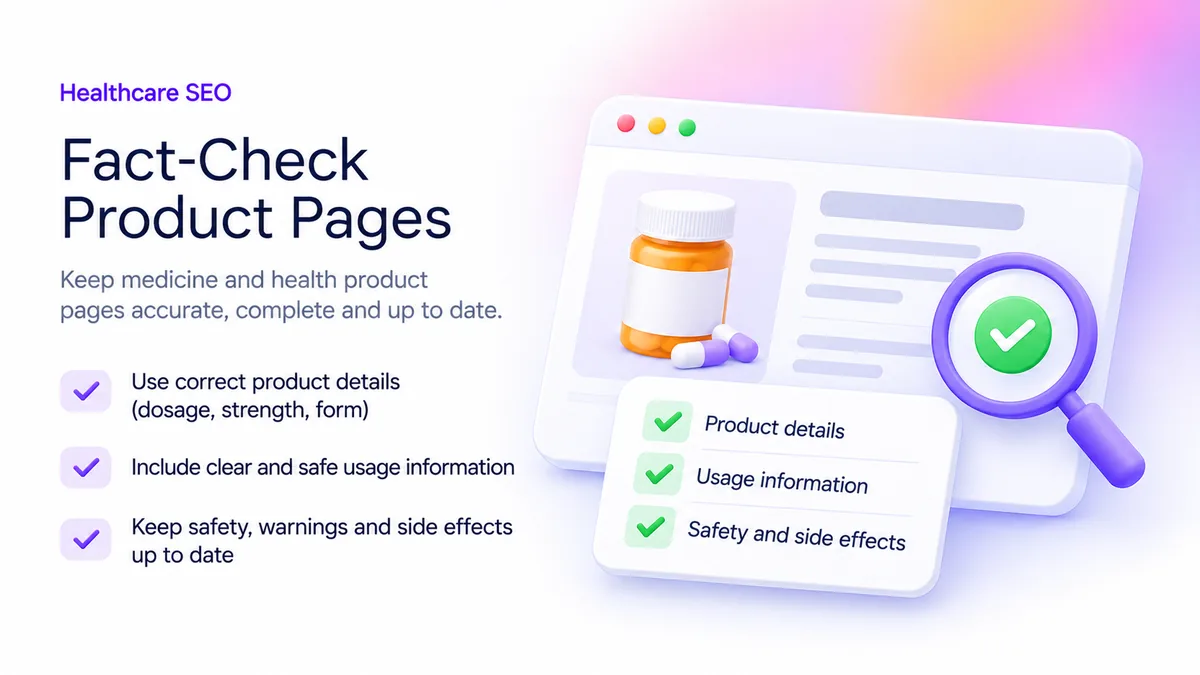
Check those six points on every product page, and re-verify each high-severity flag by hand before editing.
Know the Rules Before You Work With Publishers
In the UK, advertising prescription-only medicines to the public is prohibited. A UK news site turned down one of our expert articles partly because it couldn't confirm the linked page met those rules. Keep a few clean pages for press coverage, with no product widget, drug names or sales call to action.
Get Ads Certification and Watch Your Pixels
Google Ads requires online pharmacies and telemedicine providers to hold certification, usually from LegitScript, before advertising prescription drugs. In April 2026, this opened to pharmacies in India. Without certification, a pharmacy depends on organic search alone.
In the US, keep ad pixels off logged-in, booking and symptom-checker pages, where HHS guidance on tracking still applies.
3. Avoid the Site Structures That Get Health Sites Suppressed
One Catalog, Several Domains
Google's spam policies treat near-duplicate sites built to rank for the same searches as doorways. In our data, Google kept one site and filtered the other two.
Our two sister sites copied the main site's catalog and template, so their pages added nothing distinct. Here's what Search Console showed after the August 2026 update:
| Metric | Main site | Sister site 1 | Sister site 2 |
|---|---|---|---|
| Impressions change | Flat to up | Down 97% | Down 92% |
| URLs with impressions, zero clicks | 27% | 78% | 88% |
| Average position | 7.6 | 31 | 35 |
Source: Google Search Console, August 2026. Sites anonymized.
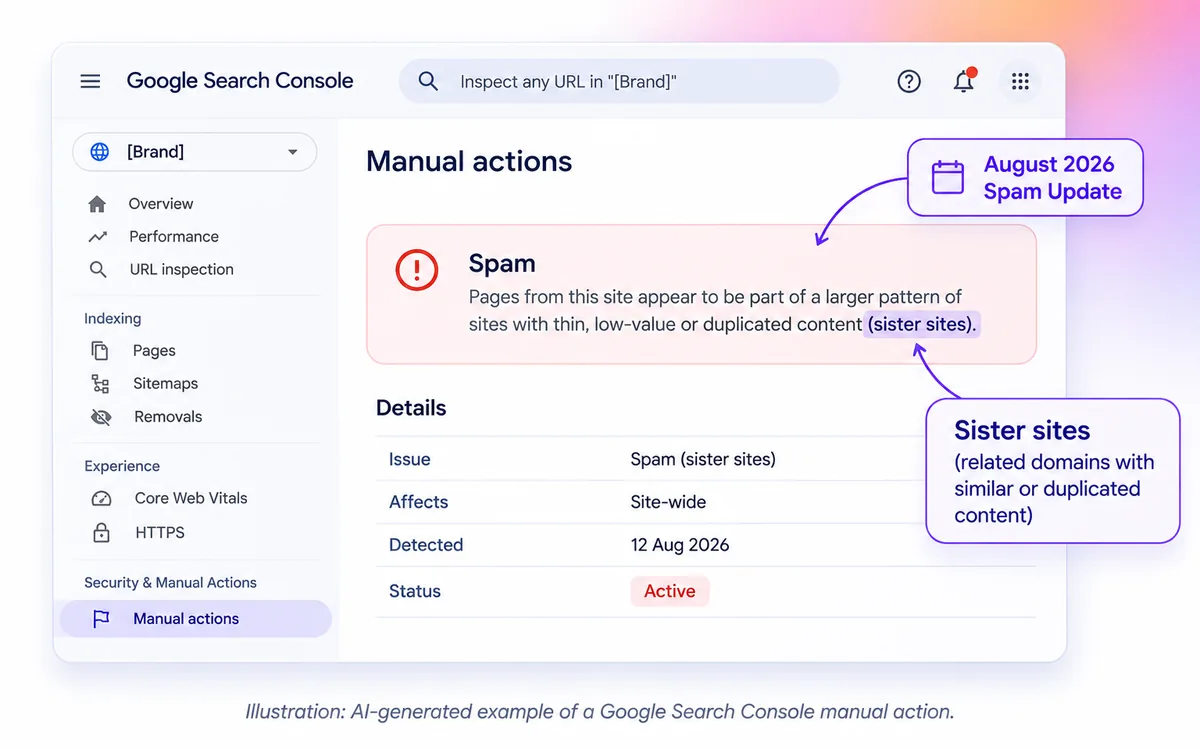
Every inspected page stayed indexed, with no manual action.
For visitors, near-identical stores add no choice. For crawlers, they're copies of the same answer, so only one ranks.
Rule of thumb
Give every extra domain its own reason to exist, such as a different audience, region or service. Otherwise, merge it into the main site, because Google is likely to filter it anyway.
Thin Template Pages
Google's scaled content abuse policy covers pages mass-produced mainly to rank, and its doorway policy names city-targeted pages that all lead to the same place. City, generic-name and condition-by-drug pages are easy to template, so health sites build them in bulk. On the hit sister site, templated URL types made up 23% of impression-earning URLs, against 3% on the main site.
Pro tip
Build a template page only when it has unique, useful information for that page. Our forecast for 567 generic-name pages showed 127 would bring about 90% of the clicks, so those were the ones worth writing well.
Keep the Index Clean
To keep a page out of Google, use a noindex tag and let Google crawl the page. If robots.txt blocks the page, Google never sees the noindex rule, and the page can stay in search results.
<meta name="robots" content="noindex">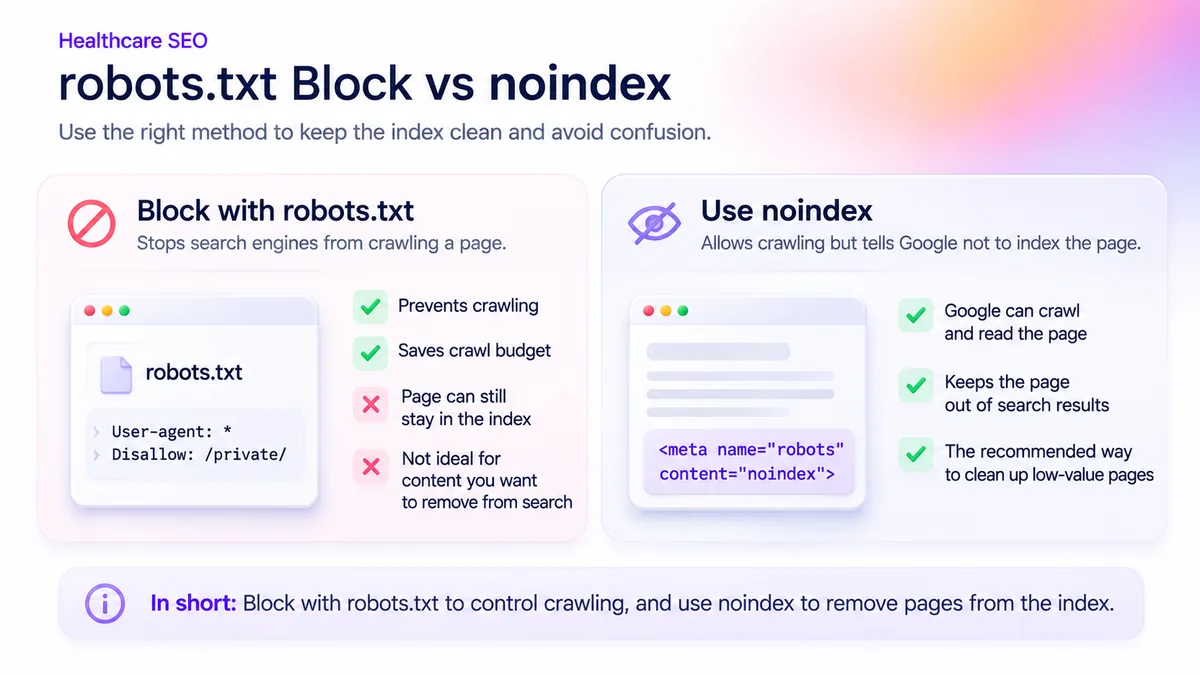
Also pick one version of your site, such as https://www., and redirect the others to it.
4. Research Keywords the Way Patients Search
Patients type "why does my chest hurt when I breathe", not "pleuritic chest pain." Map both, then target the patient's phrasing. Blog posts win awareness and comparison searches, while product pages own "price" and "buy" searches.
How to find keywords in Search Console
- Open Performance > Search results and select the Queries tab.
-
Sort by Impressions instead of Clicks.
Note: High-impression queries with few clicks are often the easiest gaps to fill.
- Export the list to Google Sheets.
- Group close variants, such as different phrasings of "amoxicillin side effects", and count their volume once.
- Remove pet queries such as "metronidazole for dogs."
On drug-name queries for one online pharmacy in 2026, we measured about 7% CTR at position 1, 1.65% at position 3 and 0.4% from positions 8 to 20. Forecast from your own data.
5. Write Content That Ranks and Gets Cited
Answer the question in the first paragraph, and make each section a passage that makes sense when quoted alone. Use question-style headings, add a short safety box, and show the author, reviewer, dates and sources. Cite primary sources such as drug labels, the NHS, CDC and NIH.
For visitors, this answers the question fast. For crawlers and AI systems, each section becomes a passage they can quote.
Answer the Follow-Up Questions
Google says AI Overviews and AI Mode may use "query fan-out", running related searches across sub-topics. We audited a post about taking an erectile dysfunction medicine after surgery and found it covered about 70% of those follow-ups. Every gap was a variant, such as dental or knee surgery, that Search Console already showed real searches for.
AI Workflow
Export a post's Search Console queries to Google Sheets, then send the headings and queries to an LLM through n8n. Ask it to flag queries no section answers, then review each one, because a model can treat two different procedures as the same.
Merge Duplicates and Plan by Topic
Merge near-duplicate posts and 301 the weaker one. When planning refreshes, prioritize whole sub-topics by group demand instead of single posts.
Use AI With a Human Accountable
Google targets low-value content at scale, not AI assistance itself. On health topics, keep a named, qualified person accountable for every fact.
6. Get the Technical Basics Right
Most health sites need only a few technical checks.
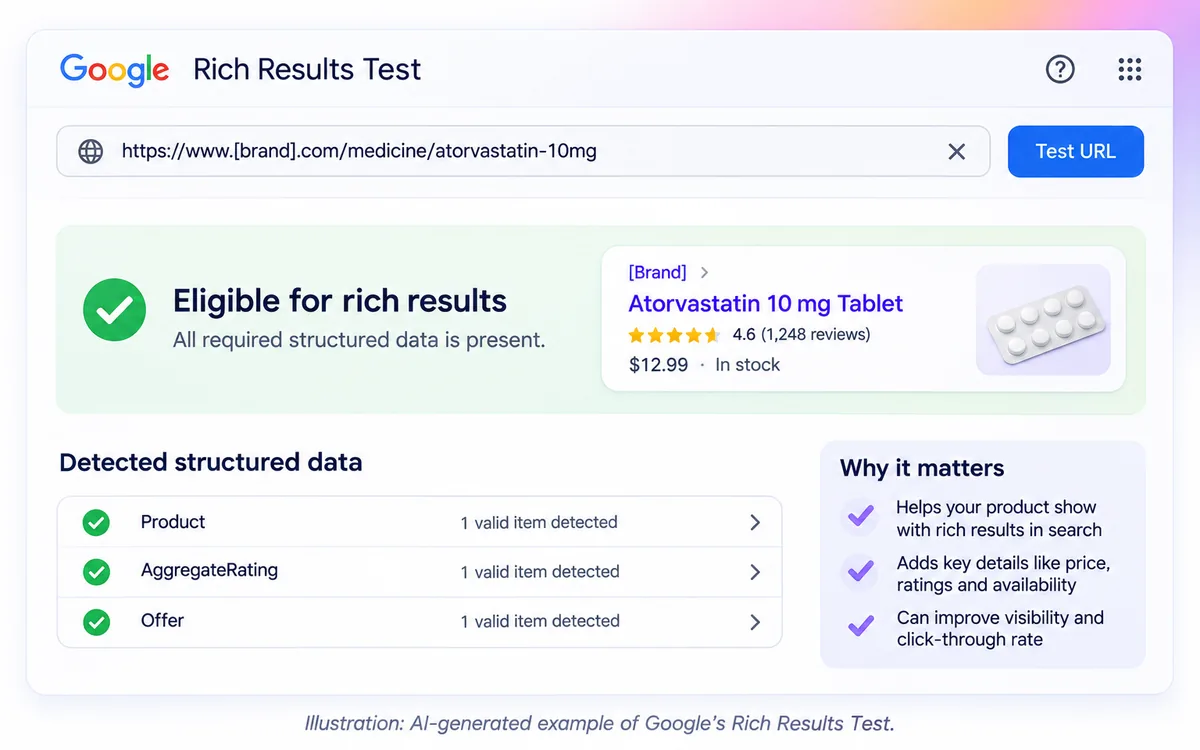
- Add Article markup with the author's name to blog posts, and Product markup with price and availability to product pages.
- Add Organization markup to your homepage, with your logo and official profiles.
- Test each template in Google's Rich Results Test.
- Check the Core Web Vitals report in Search Console, starting with mobile product pages.
-
If you move images to a new folder or CDN, redirect the old image URLs.
Note: On one pharmacy, broken image paths cut product image impressions by 57% overnight.
Note
Google stopped showing FAQ rich results for all sites on May 7, 2026. Keep FAQs for readers, but don't expect extra search space from FAQ markup. Google also says AI features need no special schema.
7. Build Internal Links That Support Your Topics
In one 397-post sexual health category, a glossary page had 424 internal links pointing to it, while the median post had 2. For visitors, the specific answers stayed buried. For crawlers, authority piled up on one broad page.
- Open Links > Top linked pages in Search Console, or crawl the site with Screaming Frog.
- Find useful posts with only one or two internal links.
- Add links to them from related posts on the same topic, using descriptive anchor text.
- Remove links to deleted or out-of-stock products.
8. Earn Off-Site Trust Carefully
Backlinks won't fix a spam update. Our August 2026 analysis ruled them out, because the update didn't target links and the site that kept its traffic had a similar backlink profile to the two that dropped.
Earn links and mentions the slow way.
Offer journalists expert comment from your verified pharmacists, link them to clean pages, and
disclose your commercial interest. Google's link spam policy says any link you pay for, in money,
products or services, must carry rel="sponsored" or rel="nofollow".
Patient communities can matter more than media. One niche patient community sent an online pharmacy 633 sessions and 27 orders without any outreach.
9. Manage the Search Results for Your Brand
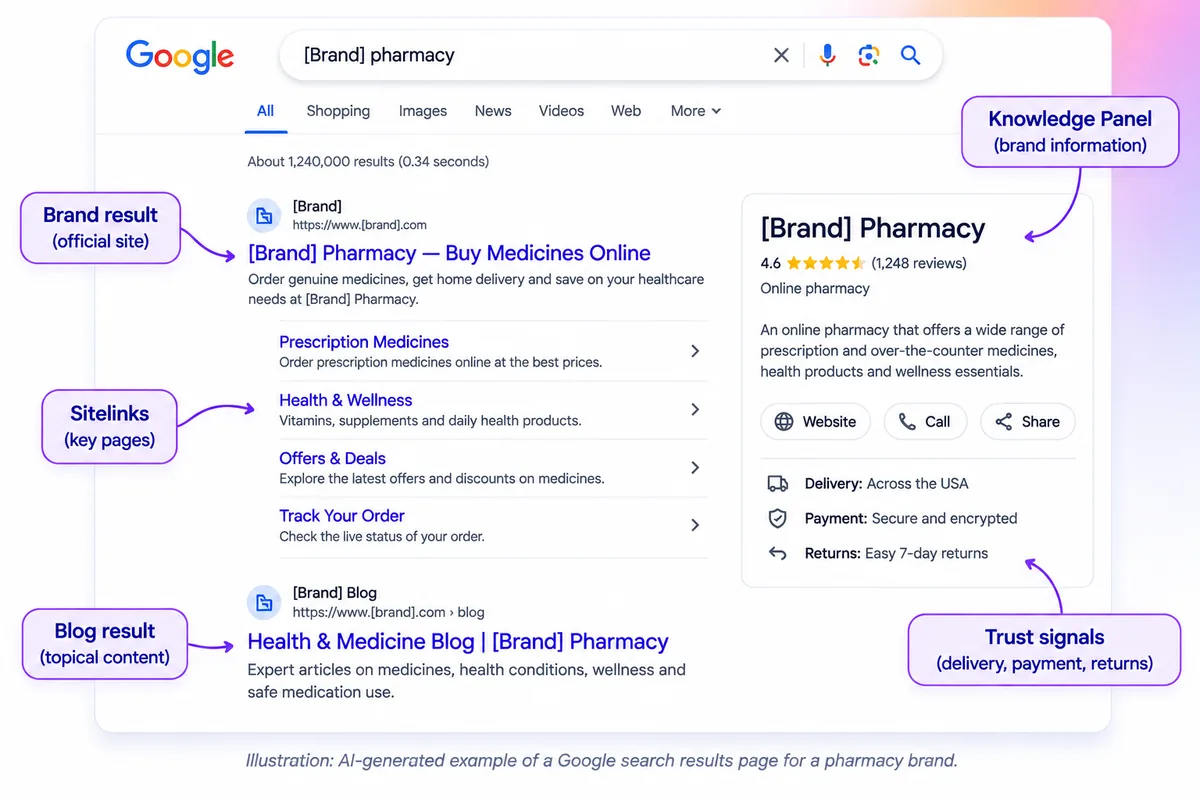
Searches like "is [brand] legit" lead to a page you don't own, and it still decides sales.
- Masked WHOIS caused most "unsafe" ratings from scam checkers we reviewed.
- Disputes work when you argue the checker's criteria. One vendor changed a "Suspicious Shop" label to a Trust Score of 75.
- Your own pages can win. On one online pharmacy, 21 of 34 AI Overview citations on brand queries were its own pages.
Rule of thumb
When a site calls you unsafe, find the exact signal it used first. The verdict often rests on one technical fact you can fix or dispute.
10. Show Up in AI Search
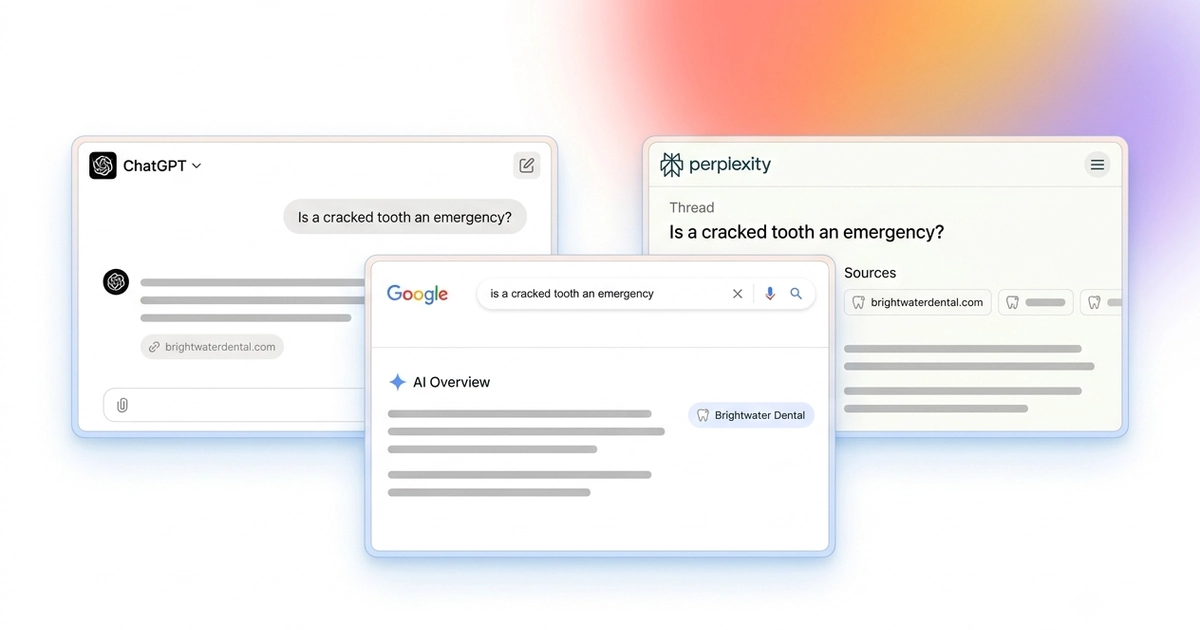
AI search optimization is SEO adapted for quoted answers, and Google says there's nothing extra to do to appear in its AI features. Studies still disagree on which health sources AI cites most, with YouTube and PubMed Central each topping a different study.
Referral traffic is still small: one online pharmacy got 118 AI assistant sessions and 2 orders from July to October 2026. Submit sitemaps to Bing too, since it feeds Copilot.
Our healthcare AEO and GEO guide covers AI crawler access, the outside profiles AI tools quote, and how to measure AI visibility.
11. Measure What Matters
On one online pharmacy, blog posts drew about 50% of organic landing sessions but converted at 0.29%, against 5.95% for product pages. Measure blogs by clicks into products instead.
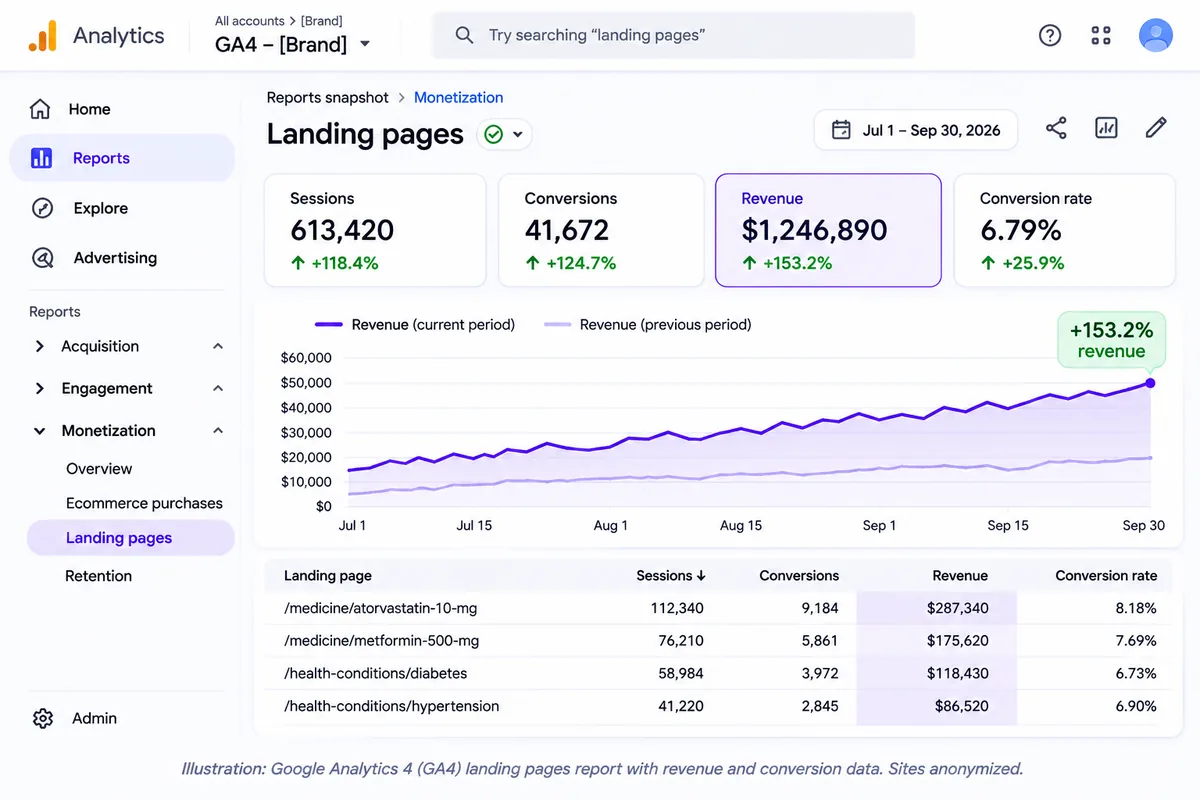
In GA4, check revenue in the Landing page report, because page-level reports credit sales to the checkout page. Compare the same number of days before and after a change.
12. How to Recover From a Spam Update
- Match the drop to Google's Search Status Dashboard.
- Check Manual actions in Search Console. If there is one, fix it and request a review.
- Inspect sample URLs. If they're still indexed, it's ranking suppression.
- Compare with a site or section that survived.
- Fix in order of evidence: fake reviews, trust pages, thin and duplicate URLs, fake authors, then reputation.
-
Track recovery over the following months.
Note: Google says its systems may take months to learn that a site now follows its spam policies.
Start With Trust, Then Grow
Healthcare SEO rewards sites that prove who is behind them and what their claims rest on. Start with authors, reviews and site structure, where health sites lose the most traffic.
For clinics, hospitals and specialist doctors, our healthcare SEO service follows the same order: clinical authorship first, then condition and procedure pages.
FAQ
Sources and further reading
- Google: Search Quality Rater Guidelines (PDF)
- Google Search Central: Creating helpful, reliable, people-first content
- Google Search Central: Review snippet structured data
- FTC: Health Products Compliance Guidance (PDF)
- LegitScript: healthcare certification for Google in New Zealand and India (April 2026)
- Google Search Central: Spam policies for Google web search
- Google Search Central: Block search indexing with noindex
- Google: Rich Results Test
- Search Engine Journal: Google drops FAQ rich results (May 2026)
- Google Search Central: AI features and your website
- Google Search Status Dashboard
- Google Search Central: Spam updates
How we write our guides
Written by the EEAT Media team from our own client work. Client sites are never named. A person checks every claim and source against the original before it is published, and every substantive change is dated below.
Change log
- First published.
EEAT Media is not affiliated with Google or with any tool, platform or company named in this guide. Client sites are anonymized.