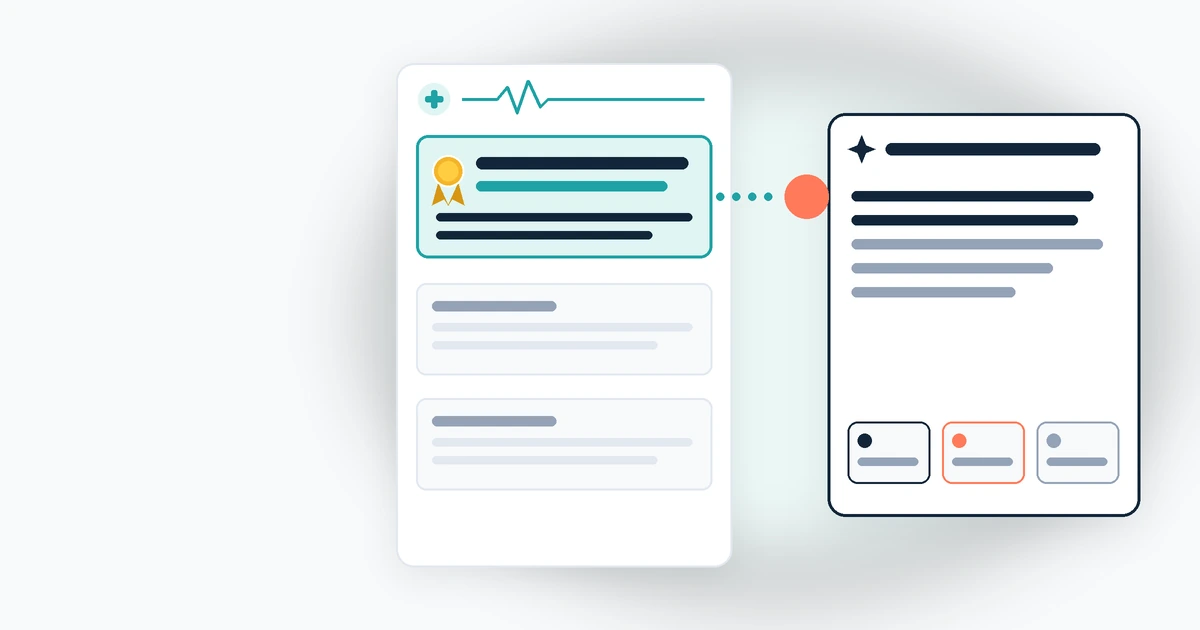
Guide · SEO
Complete Guide for Healthcare AEO and GEO: How to Get Cited by ChatGPT, Perplexity and AI Overviews
How AI tools choose which health pages to cite, and what clinics can fix first.
Key takeaways
- AI tools cite health pages they can crawl, read and check, so SEO basics still decide most of the outcome.
- When patients ask ChatGPT for a doctor, it mostly cites pages the practice doesn't own, such as hospital rosters and board profiles.
- Let AI search crawlers in, publish specific procedure and provider pages, fix your outside profiles, then measure.
On this page
- Why AEO and GEO matter
- 1. How AI tools choose sources
- 2. Two kinds of patient searches
- 3. Let AI tools read your site
- 4. Pages AI can quote
- 5. Who stands behind the advice
- 6. Pages AI reads about you
- 7. Safe and compliant
- 8. What you can skip
- 9. Measure AI visibility
- Start with what AI can read
- FAQ
- Sources
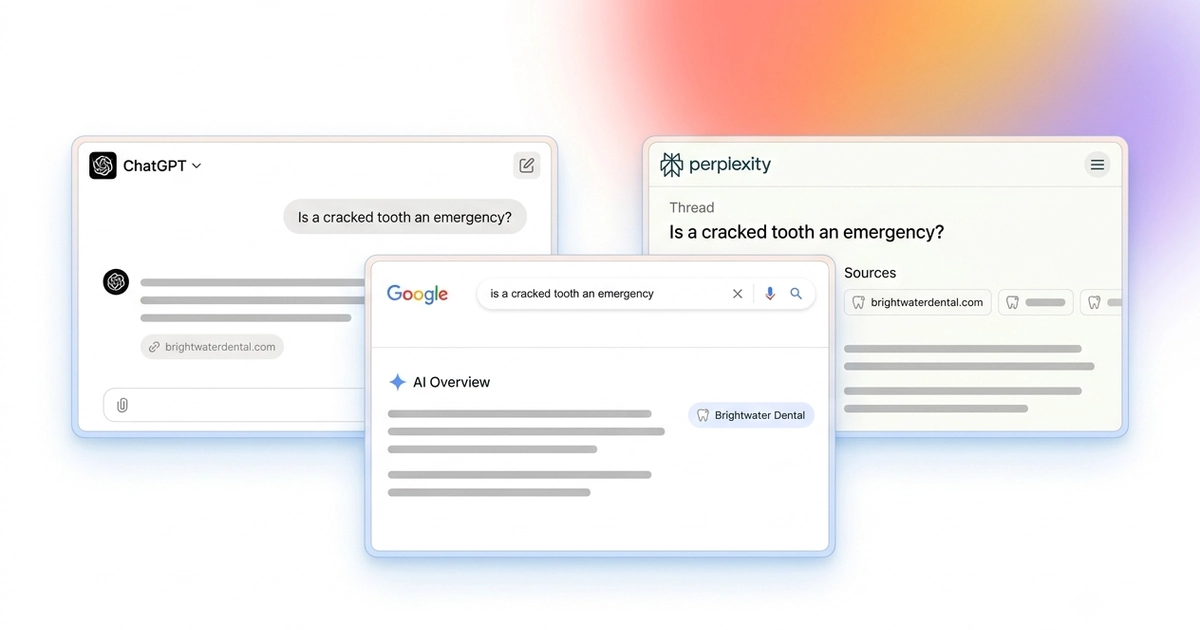
Healthcare AEO (answer engine optimization) and GEO (generative engine optimization) both describe getting a clinic or health website named and linked inside AI answers. Those answers appear in Google's AI Overviews and AI Mode, ChatGPT, Perplexity and Copilot. Think of an AI assistant as a busy referral coordinator. It reads a few sources it trusts, writes the patient a short note, and only names clinics it can vouch for.
Google's own guide mentions both terms and says that optimizing for its AI features is still SEO. We agree, so this guide treats AEO and GEO as SEO adapted for answers that get quoted.
Why Healthcare AEO and GEO Matter
In January 2026, OpenAI said over 230 million people a week ask ChatGPT health and wellness questions. A KFF poll from early 2026 found that 32% of US adults had used AI for health information in the past year.
For visitors, an AI answer turns ten links into a short list of names. A clinic left off that list may never be considered. For crawlers, the rule is simpler: an AI tool can only cite a page its crawler was allowed to fetch and could read.
Low AI visibility is often blamed on a missing AI file or special markup. In the research we reviewed, the bigger factors were which sources exist about a practice, and how specific its own pages are.
Health answers also carry risk. In January 2026, Google removed AI Overviews from some liver test searches after a Guardian investigation found misleading answers. AI tools have every reason to prefer careful, verifiable health pages.
1. How AI Tools Choose Which Health Pages to Cite
Google's AI Overviews and AI Mode search the Google index, read the pages they retrieve, and link to the ones that support the answer. Both may use "query fan-out", running related searches in the background. A question about knee replacement recovery might also pull in pages on physical therapy and warning signs.
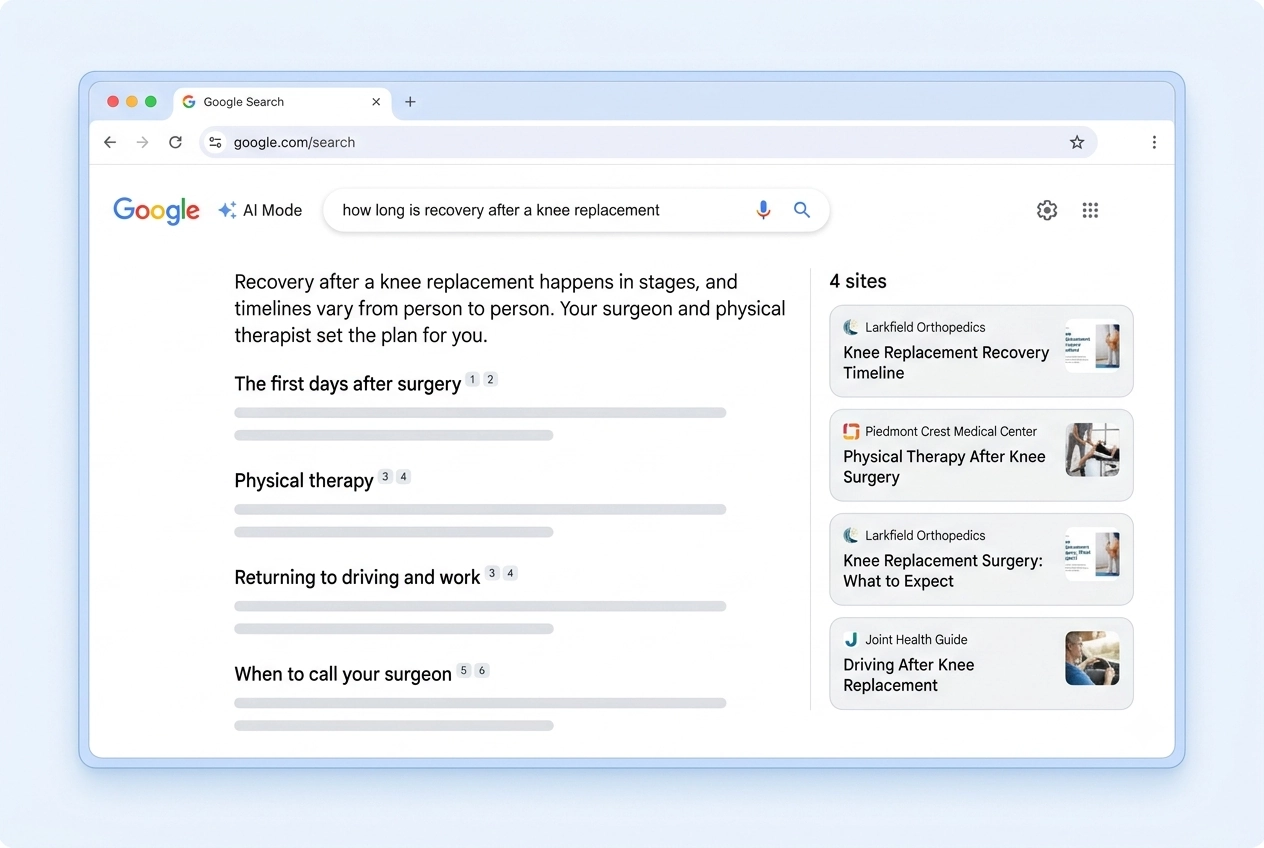
Other tools work the same way with their own crawlers. ChatGPT search uses OAI-SearchBot, Perplexity uses PerplexityBot, Claude uses Claude-SearchBot, and Copilot draws on Bing.
A citation is a source the AI used. A mention is the name the patient sees. An AI can name your practice from someone else's page, so an outdated profile can send a patient to an old address.
What ChatGPT Cites When Patients Ask for a Doctor
A 2026 research series in Medical Economics, run by an AI platform for independent practices, tested 200 practices picked at random from the NPPES registry. Across about 4,950 patient-style prompts, ChatGPT cited and named none of them.
A second dataset classified about 33,000 ChatGPT citations behind physician answers:
| Source type | Share of citations |
|---|---|
| Hospital and academic staff rosters | 27.5% |
| Practice-owned websites | 23.0% |
| Specialty-board and association profiles | 22.1% |
| National directories | 8.3% |
| State medical-board license lookups | 5.1% |
| Review sites | 3.8% |
Source: Medical Economics, ChatGPT only, US only, May 2026.
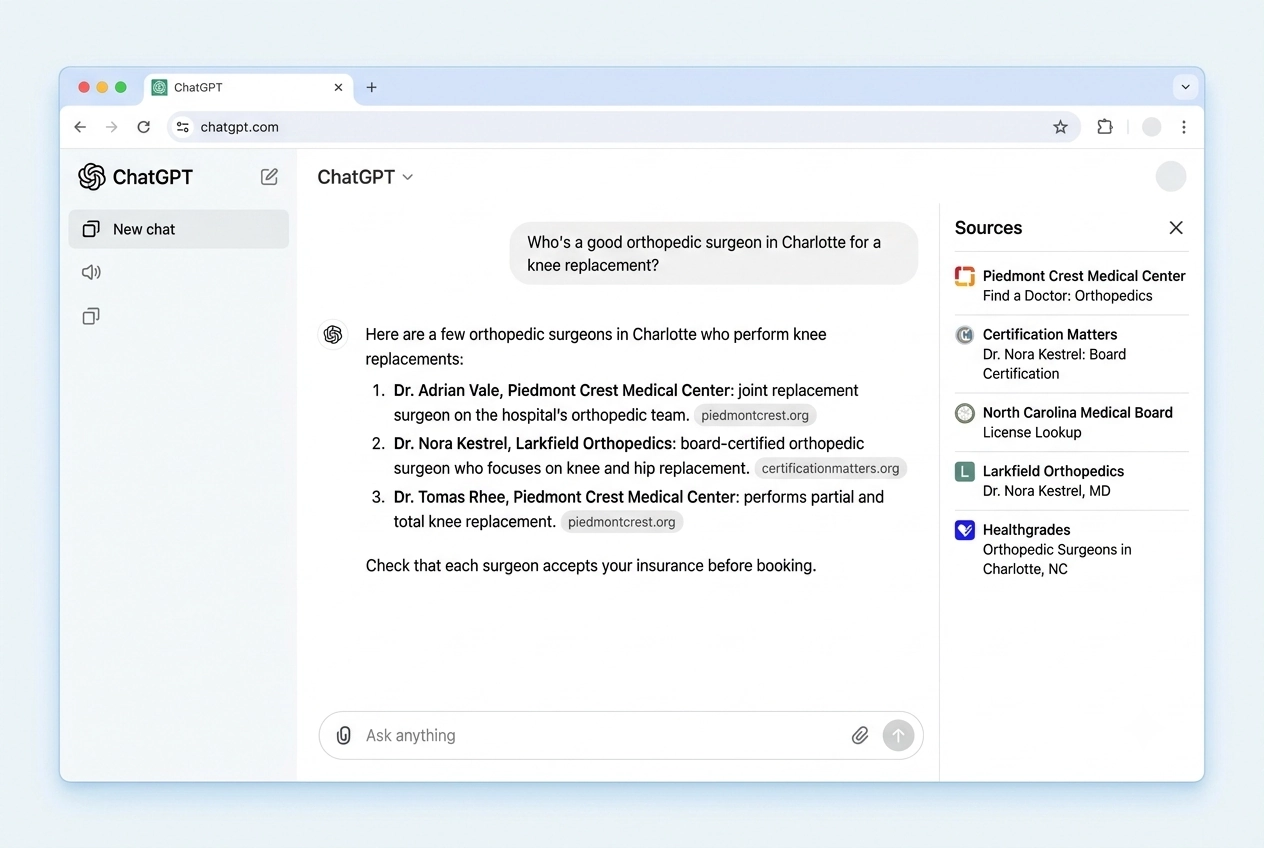
No citation pointed straight to a Google Business Profile. Results also varied by specialty and city, so compare yourself with practices like yours.
Read more
If your health pages rank in Google but rarely show up as AI sources, our guide to the healthcare citation gap shows how to confirm it and what to fix first.
2. Know the Two Kinds of Patient Searches
"Dentist near me" and "is a cracked tooth an emergency" get very different results. A Whitespark study ran 540 searches in three US cities, including for dentists, optometrists and medical clinics.
| Search type | Example | AI Overview shown |
|---|---|---|
| Informational | "how long does a root canal take" | 92% |
| Question plus a place | "best treatment for knee pain in Denver" | 97% |
| Local intent | "primary care clinic Phoenix" | 15% |
Source: Whitespark, May 2025. Examples are our illustrations.
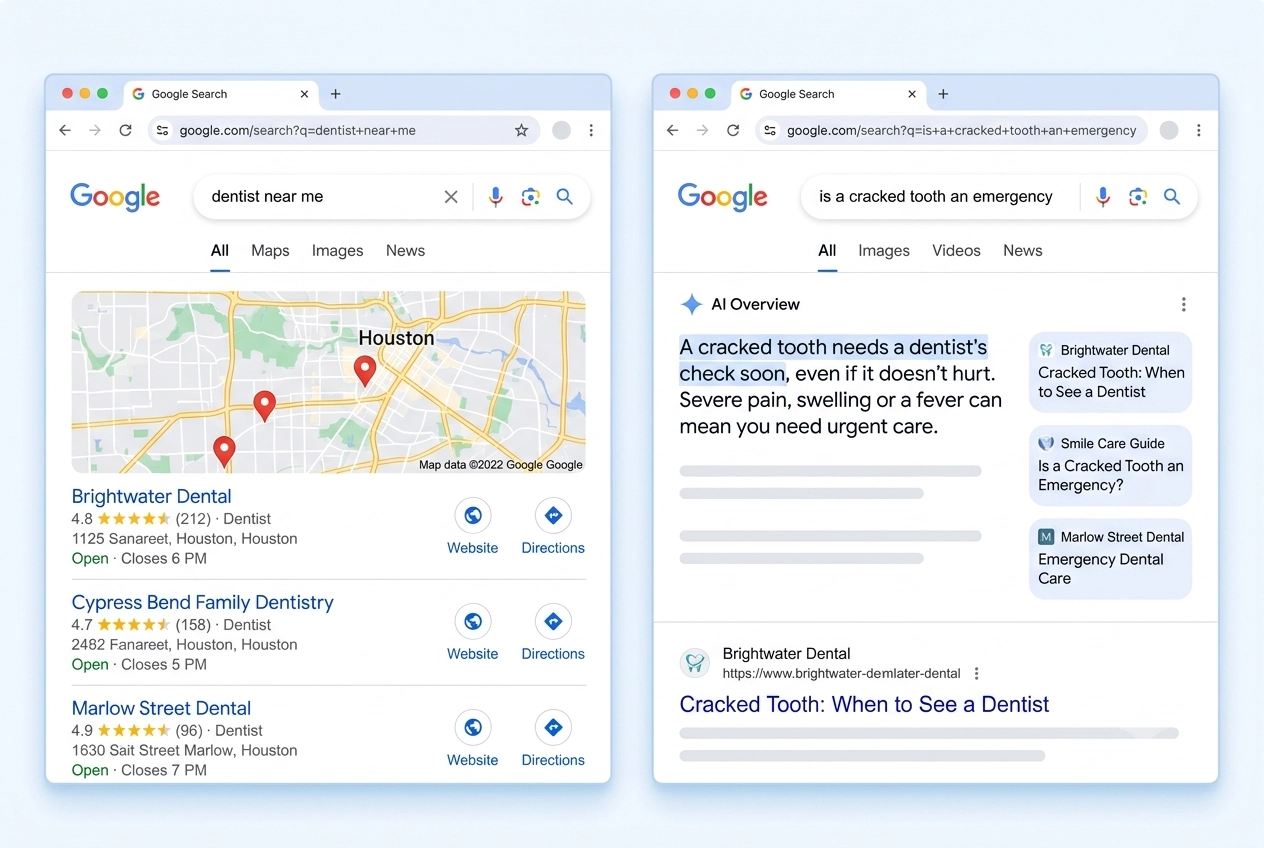
For visitors, a local search ends in a call or booking, and a question ends in an answer. For crawlers, the first relies on your Business Profile, and the second relies on pages Google can quote. In ChatGPT, patients also ask for recommendations in full sentences, and those answers lean on the outside sources in section 6.
Rule of thumb
Keep your Business Profile complete for "near me" searches, and build pages for the questions patients ask. Each search reads a different source, so one can't cover for the other.
3. Make Sure AI Tools Can Read Your Site
To appear in Google's AI features, a page must be indexed and eligible for a snippet. Other AI tools also need their own crawler allowed in.
Check Your Robots.txt and CDN
Each company runs separate crawlers for search and for training, so you can appear in AI search without offering content for training.
| Company | Search answers | Model training |
|---|---|---|
| Googlebot | Google-Extended | |
| OpenAI | OAI-SearchBot | GPTBot |
| Perplexity | PerplexityBot | Not used for training |
| Anthropic | Claude-SearchBot | ClaudeBot |
| Microsoft | Bingbot | n/a |
Sources: each company's crawler documentation, November 2026.
Here's an example for a clinic that wants AI search visibility but no training:
User-agent: OAI-SearchBot
User-agent: PerplexityBot
User-agent: Claude-SearchBot
Disallow: /admin/

User-agent: GPTBot
User-agent: ClaudeBot
User-agent: Google-Extended
Disallow: /
Note
A crawler follows only the most specific group that names it, so repeat any folder blocks from
your User-agent: * group, as shown.
Blocking Google-Extended doesn't remove you from AI Overviews, because Googlebot controls all of Search. Then check your CDN or firewall. Since July 2025, Cloudflare has asked new domains whether to allow AI crawlers, and security plugins can block them too.
Keep Google's Generative AI Setting On
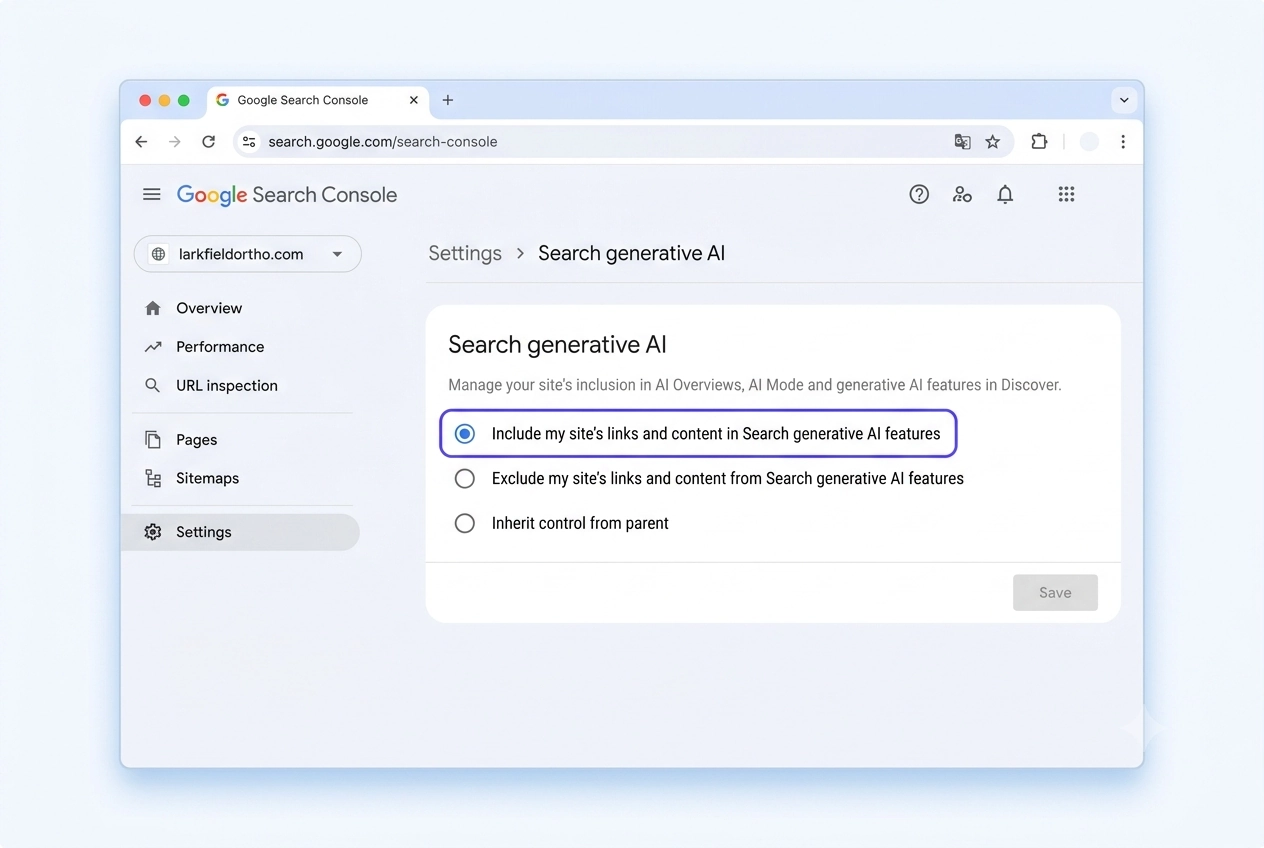
Since August 31, 2026, Search Console has a Search generative AI control for AI Overviews and AI Mode.
- Open Search Console and select your property.
- Go to Settings, then Search generative AI.
-
Confirm it's set to include your site.
Note: Including is the default, and Google says the control doesn't affect rankings elsewhere in Search.
Put Core Facts in the HTML
Google can process JavaScript, but other AI crawlers say less about it. Open a provider page, choose View page source, and search for the doctor's name and address. If they're missing, ask your developer to render them on the server.
Also submit your sitemap to Bing Webmaster Tools, since Copilot draws on Bing's index.
4. Publish Pages AI Can Quote
Google says unique, useful content will likely influence your AI presence more than anything else in its guide. A services page that says "we offer comprehensive orthopedic care" is commodity content. A page explaining who your surgeon treats and what recovery looks like is not.
The Medical Economics research found the same thing: ChatGPT's description of a practice was only as specific as what the practice had published.
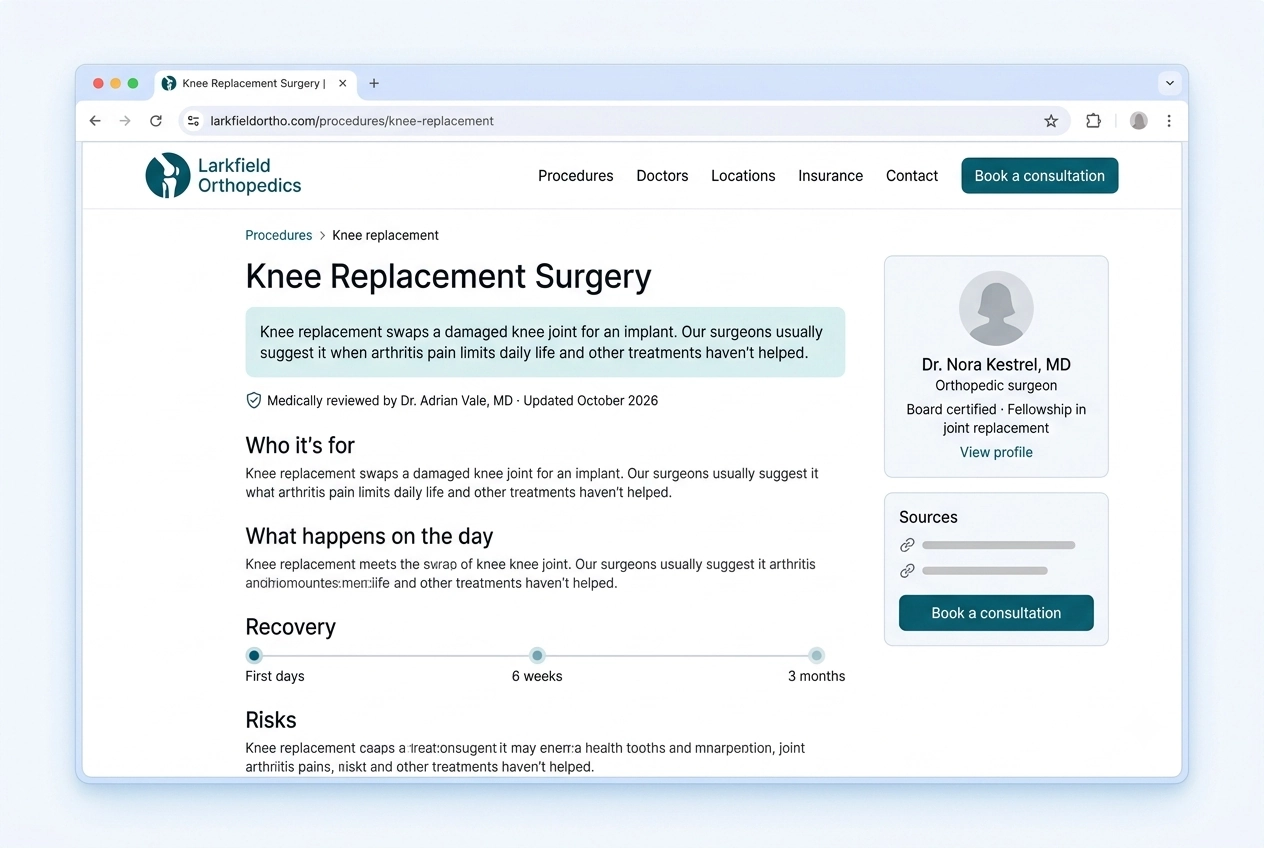
Give each main procedure or condition its own page, covering:
- what it is, in plain words, in the first paragraph
- who it suits and who it doesn't
- what happens on the day, and recovery
- risks, stated calmly
- who performs it, with their training
Give every clinician a page with their credentials, license, specialties, procedures, locations and whether they take new patients. Give every location a page with its address, hours and services. Answer cost, insurance and appointment questions too, or the AI takes those answers from a directory.
Pro tip
Write each provider's details once on your site, then copy that wording into every outside profile. When every source matches, an AI tool has nothing to reconcile.
Cover Follow-Up Questions in the Same Page
Google warns that making pages for every fan-out query mainly to manipulate AI answers breaks its scaled content abuse policy. Answer follow-ups inside the page they belong to. When we audited one online pharmacy post in 2026, it covered about 70% of follow-up questions. Every gap was a variant patients were already searching for.
AI Workflow
Export a page's Search Console queries to Google Sheets, then send the headings and queries to an LLM through n8n. Ask it to flag queries no section answers, then review each one, because a model can treat two procedures as the same.
5. Show Who Stands Behind the Advice
Show the author, the medical reviewer, their credentials, the review date and your sources. Every signal has to be real, because Google calls fabricated creator profiles deception. Our healthcare SEO guide covers how to set up real reviewers and check their licenses.
6. Fix the Pages AI Reads About You
In the Medical Economics data, five sources carried about four in five ChatGPT citations for physicians. Audit them in this order:
- Your website. It's the reference copy, so get names, credentials, addresses and phone numbers right first.
-
Specialty-board and association profiles. Check the practice, address, certification and affiliations.
Note: The most common error was a stale address left by a former employer.
- State medical-board record. The board's site names the office that handles corrections.
- Regional Top Doctors lists. Find out who runs your city's list and when nominations close.
- Hospital and academic rosters. Ask the medical-staff office to fix errors.
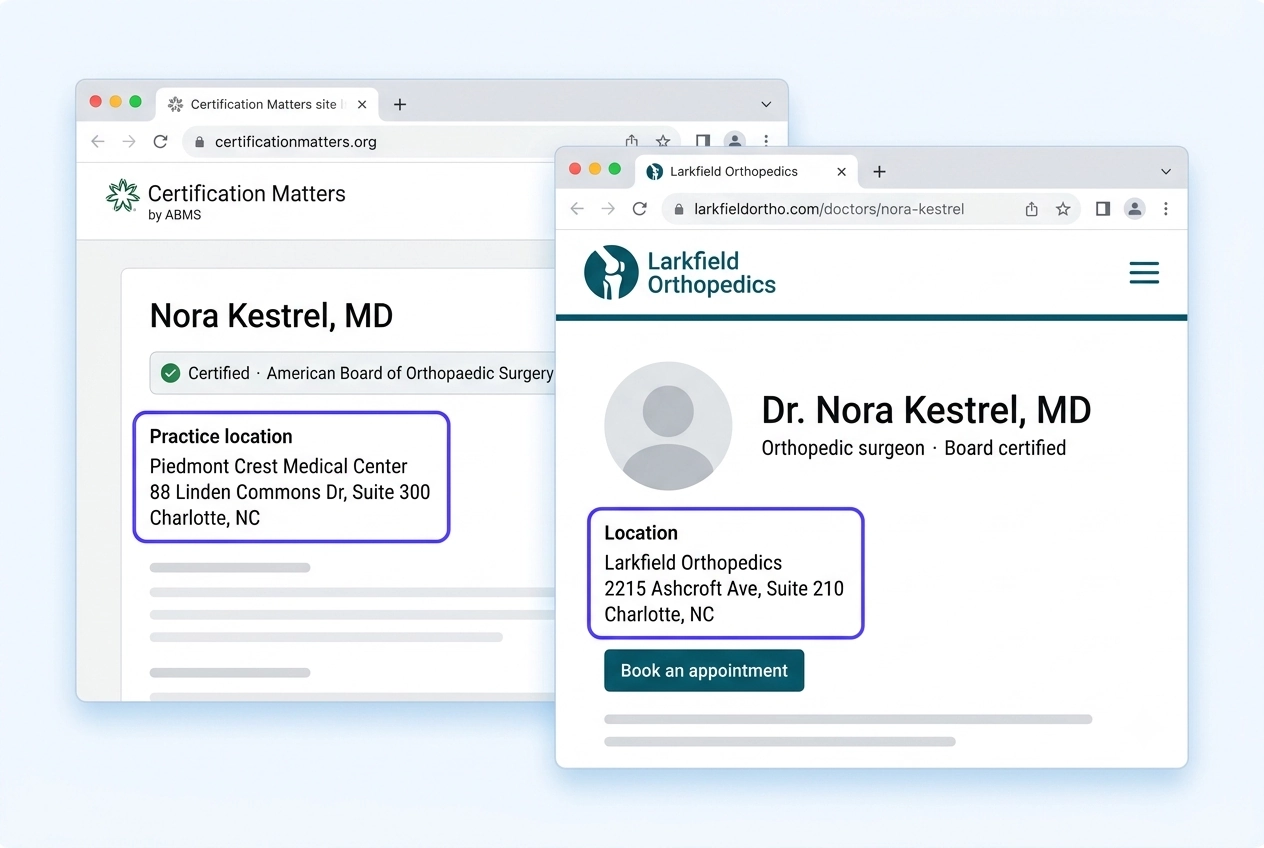
Outside the US, check your regulator's register, such as the GMC in the UK or India's Indian Medical Register. Also keep your Business Profile and main directories current, since Google's AI guidance names Business Profile directly.
Reviews were only 3.8% of ChatGPT's citations, but they still shape the map pack and patient choice. On one online pharmacy in 2026, an AI Overview on a brand search quoted a review page built from a burst of one-star reviews.
Your own pages can win brand questions too. On the same pharmacy, 21 of 34 AI Overview citations across five brand searches were its own pages, led by its "is it legit" page. For a clinic, that page shows licenses, who runs the practice and links to independent reviews. Our healthcare SEO guide covers managing brand search results in more detail.
Google says chasing inauthentic mentions isn't as helpful as it seems. Earn mentions through local press and expert comment from your clinicians.
7. Stay Inside Safe and Compliant Lines
The liver test answers Google removed gave ranges without saying they vary by sex and ethnicity, according to reporting on the Guardian's findings. Give the general answer, say who it doesn't apply to, and say when to see someone.
Follow the FTC's Health Products Compliance Guidance on health claims, and keep ad pixels off patient portals and booking flows. If AI helps you draft, a named clinician should still check every fact.
8. What You Can Skip
| Common advice | What the evidence says |
|---|---|
| Add an llms.txt file | Google says its Search ignores it. |
| Medical schema makes AI cite you | Ahrefs tracked 1,885 pages that added schema and found no measurable citation gain. |
| FAQ markup wins extra space | Google stopped showing FAQ rich results on May 7, 2026. |
| Break content into small chunks | Google says there's no need. |
| Get mentioned everywhere, any way | Google says inauthentic mentions don't help much. |
| Make a page for every question | That can break Google's scaled content abuse policy. |
Schema still makes pages eligible for rich results, and it labels the doctors and locations your pages already describe.
Rule of thumb
Before paying for an AEO or GEO tactic, check that the search company's own documentation supports it. Google says no third-party tool can see inside its ranking or AI systems.
9. Measure Your AI Visibility
No single report shows every citation, so combine three free reports with a monthly test.
- Search Console: the Generative AI performance report shows AI Overview and AI Mode impressions by page. It has no click data.
- Bing Webmaster Tools: the AI Performance report shows citations in Copilot and Bing's AI summaries. Bing says the data is sampled and shows no clicks.
- GA4: ChatGPT clicks arrive with
utm_source=chatgpt.com. In Traffic acquisition, view Session source / medium and look for chatgpt.com, perplexity.ai and copilot.microsoft.com.
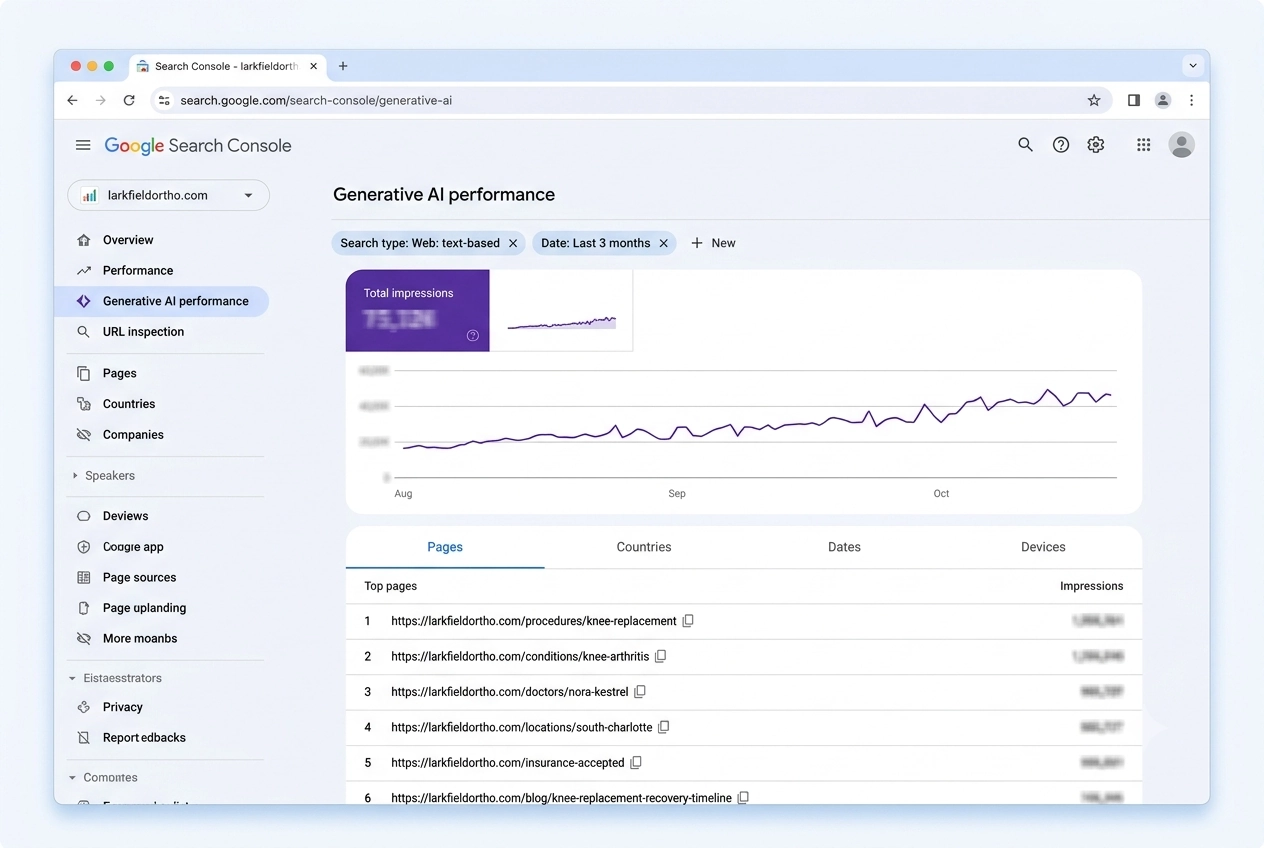
Expect small numbers. On one online pharmacy, AI assistants sent 118 sessions and 2 orders from July to October 2026.
None of these reports cover ChatGPT or Perplexity citations, so run a monthly prompt test:
- Write 20 to 30 questions a patient would ask about your specialties in your city.
- Run each in ChatGPT, Perplexity and Google, more than once, since answers change.
- Record whether your practice is cited or named, and which sources appear.
- Repeat with the same questions each month.
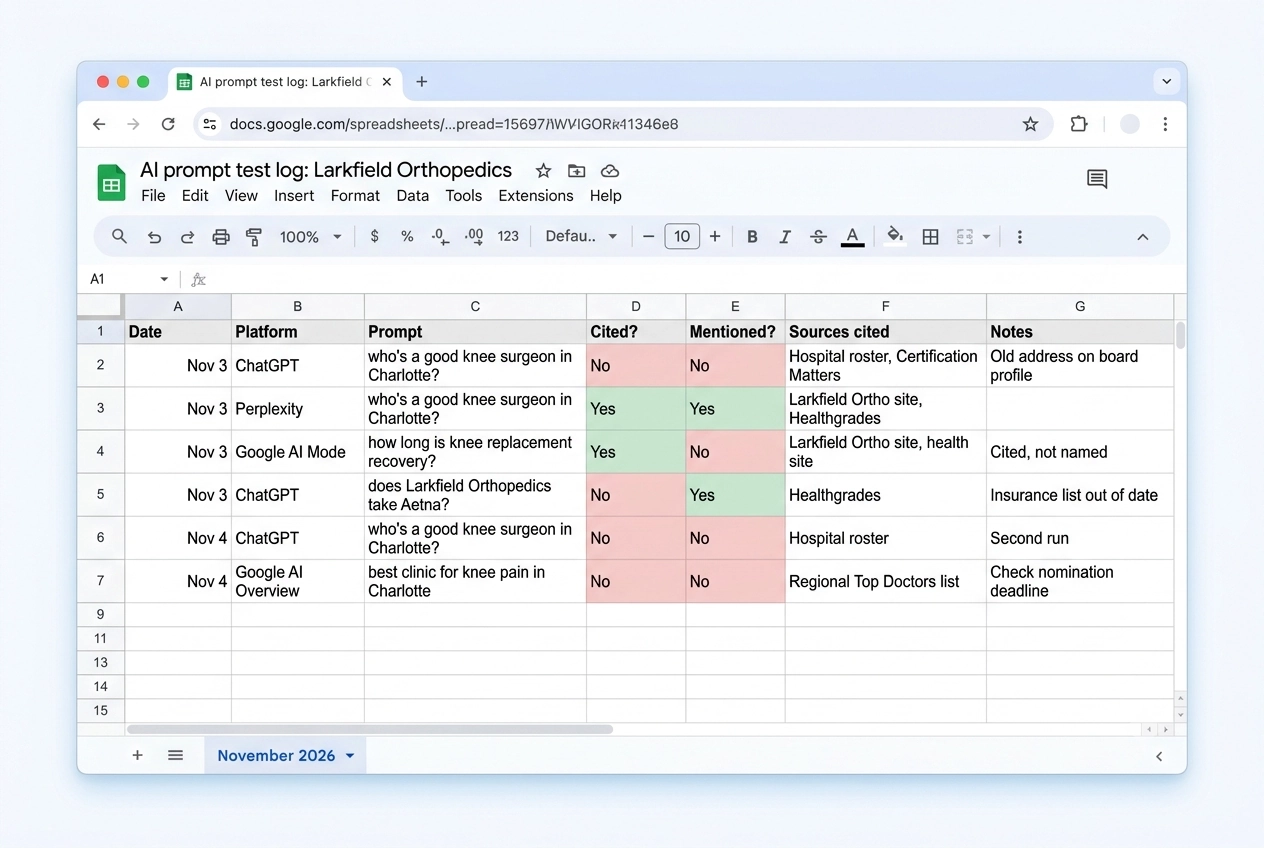
The sources column shows which outside profiles AI tools rely on for your specialty, so you know which ones to fix next.
Start With What AI Can Read
Healthcare AEO and GEO start with the basics: let AI search crawlers in, publish specific pages, and correct the outside profiles AI tools quote. Then measure with Search Console, Bing and a monthly prompt test.
For clinics, hospitals and specialist doctors, our healthcare SEO service covers this work alongside the rest of your search visibility.
FAQ
Sources and further reading
- Google Search Central: Optimizing your website for generative AI features on Google Search
- Google Search Central: AI features and your website
- Search Console Help: Search generative AI control
- Search Console Help: Generative AI performance report
- OpenAI: Overview of OpenAI crawlers
- Perplexity: Perplexity crawlers
- Anthropic: Does Anthropic crawl data from the web, and how can site owners block the crawler?
- Bing Webmaster Tools: AI Performance
- Medical Economics: Why ChatGPT favors hospitals over independent practices (July 2026)
- Medical Economics: Before you pay for AI visibility for your practice, audit these five sources (August 2026)
- Whitespark: The prevalence of AI Overviews in local search (May 2025)
- Ahrefs: Schema and AI citations (May 2026)
- OpenAI: Introducing ChatGPT Health (January 2026)
- KFF: Use of AI for health information and advice (March 2026)
- TechCrunch: Google removes AI Overviews for certain medical queries (January 2026)
- FTC: Health Products Compliance Guidance (PDF)
How we write our guides
Written by the EEAT Media team from our own client work. Client sites are never named. A person checks every claim and source against the original before it is published, and every substantive change is dated below.
Change log
- First published.
EEAT Media is not affiliated with Google, OpenAI, Perplexity, Anthropic, Microsoft or any other company named in this guide. Screenshots are illustrations: the clinics, doctors and addresses in them are fictional. Client sites are anonymized.